What is cannabis?
Cannabis is a plant with a long history and lots of nicknames like weed, pot, or bud. It comes in many different types and forms, and it’s the second most-used psychoactive substance in Canada after alcohol.
Whether you're just curious or already familiar, this guide will help you understand what cannabis is, how it works, and what to know before if you choose to use it.



Meet the major cannabinoids
Cannabinoids are the star players of cannabis. Two of the most well-known are THC (tetrahydrocannabinol) and CBD (cannabidiol). But what’s the difference?
THC: The high-flyer
THC, which also goes by its scientific name tetrahydrocannabinol, is the chemical compound responsible for how your brain and body respond to cannabis. It’s the main psychoactive compound that gives you that “high” feeling.
- The concentration or strength of a cannabis product is usually shown as a percentage of THC by weight (or volume in oil).
- THC is available in several varieties, with delta-9 THC being the most common and potent. Lesser-known forms like delta-8 and delta-10 THC are also intoxicating but generally milder.
- The key takeaway? If it’s THC, it’ll affect your brain and the higher the THC, the higher the risk, so start low and go slow, especially if you’re a new or returning user. Learn more about the effect.
Quick Tip: In Alberta, cannabis products containing only minor cannabinoids (like delta-8 or delta-10) aren’t available for sale due to limited research on their effects. Health Canada is still studying their effects
THC delta-9 is the major cannabinoid, meaning that there are large amounts of it in cannabis plants. It is also the most common type of legal THC sold in the Canadian market and is more potent than delta-8 and delta-10.
THC delta-8 and delta-10 are sometimes called minor cannabinoids, because the cannabis plant produces a lot less of these compared to the major cannabinoids. These trace cannabinoids occur at such low levels that researchers have developed different techniques to extract them. The intoxication effects of delta-8 and 10 are less than delta-9.
Many users might think that when it comes to the delta, the bigger the number the bigger effect, which isn’t necessarily correct. Out of the three deltas, delta-9 produces the most mind-altering effects. However, when used in larger amounts, minor cannabinoids like delta-8 and delta-10, can have similar mind-altering effects.
When different types of THC (like any of the deltas) are combined, the intoxicating effects can be unpredictable. Numbers aside, if you see delta listed as an ingredient, remember that it’s THC and it will interact with your brain to cause intoxication when consumed. Start low and go slow if you are a new or returning user.
In Alberta, retailers cannot sell products that contain only minor cannabinoids because more research is needed on the effects. Health Canada is currently researching the health and safety effects of minor cannabinoids.
CBD: The balance keeper
Cannabidiol is the scientific name for CBD, which is another major cannabinoid found in cannabis. CBD is non-psychoactive, meaning it won’t get you high. Instead, it can help balance out the effects of THC.
- Choosing products with a higher CBD content can reduce some of the unwanted side effects, like anxiety or sedation.
- High amounts of CBD have been shown to reduce some of the risks around intoxication, sedation and heart health associated with THC.
- Trace cannabinoids, delta-8 and delta-10 are found at very low levels, in CBD, but don’t produce any mind-altering effects until they are extracted and concentrated.

In Alberta, retailers cannot sell products that contain only minor cannabinoids because more research is needed on the effects. Health Canada is currently researching the health and safety effects of minor cannabinoids.
What are terpenes?
Cannabis isn’t just about THC or CBD (aka cannabinoids). It also has terpenes (pronounced tur-peens) which are natural parts of plants that give them their unique smell, taste and even some of its effects. There are over 400 different types of terpenes, but here are the common ones and what they smell like:
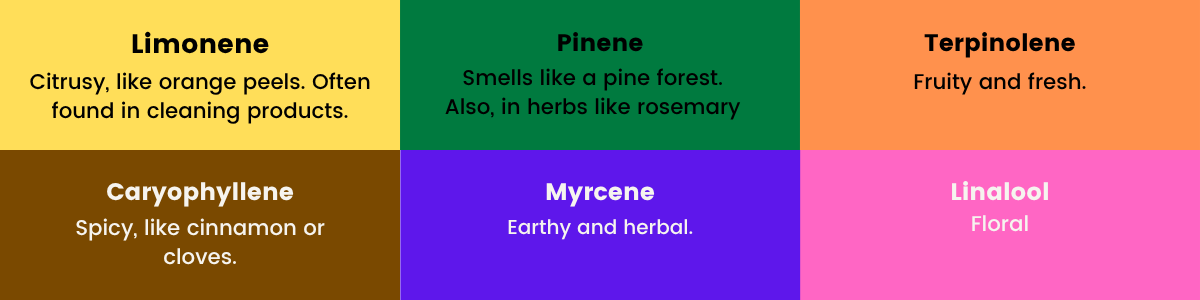
How cannabis is made can change how many terpenes are in it, which affects the smell and taste. Alberta licensed producers use terpenes to make cannabis taste and smell better.
Some researchers out there have looked into how terpenes might also change how cannabis makes you feel. For example, myrcene, found in mangos and lemongrass, might help you feel calm. But this isn’t fully scientifically backed. This is called the “Entourage Effect.”
What is the entourage effect?
Together, terpenes and cannabinoids work to create the entourage effect, which means that when they are combined they are stronger feeling than when they are consumed alone. That’s why different cannabis strains can make people feel different things—relaxed, energized or even focused. Scientists are still looking into this as it isn’t fully proven yet but is an interesting area of research.
Visit our Know the effects page to learn more about cannabis effects.
You might know your cannabis strain and its THC content, but do you know what else is in there? Legal cannabis in Canada is rigorously tested to ensure it’s free from harmful toxins and impurities. Visit our Buy legal page to learn more.
The buzz around strains
There are three commonly known strains of cannabis:
- Sativa Plants: Taller with longer, narrow leaves. Believed to provide energetic and uplifting effects. Strains often have ‘haze’ in their name.
- Indica Plants: Shorter with broad leaves. Known for sedative, euphoric, and relaxing effects. Strains often have ‘kush’ in their name.
- Hybrids: Most recreational cannabis available on the market will come from hybrid plants that contain characteristics of both indica and sativa. Breeders and growers love to make new strains, the majority being hybrids.
You might have heard of Sativa and Indica strains. Traditionally, Sativa is known for a more energetic, cerebral(head) effect, while Indica is associated with a relaxing, body-heavy feeling. However, these distinctions are increasingly blurred due to hybrid strains and modern cultivation techniques. Instead, experts now use terms like chemovars to differentiate cannabis by its chemical makeup rather than strain alone.
Know what you’re consuming
It’s just good cannabis sense to know what you’re putting into your body. You can trust that legal cannabis is tested and regulated. Look for the label, ask your retailer questions and stay informed. If you are buying online, ensure the site you are ordering from is legal by checking Cannabis licensee search | AGLC.
What shouldn’t be in your cannabis—bugs and mould are top of the list
Did you know that all legal cannabis is tested for harmful toxins and contaminants? Unfortunately, the same for unregulated or illegal cannabis products can't be said. For example, the BC government did test on illegal cannabis and found unacceptable levels of pesticides, fungi, bacteria, lead and even arsenic, which is definitely not what you want to consume. Meanwhile, legal and regulated cannabis is regularly proven to be compliant.
Here are the top impurities that legal cannabis is tested for in Canada:
Vaping products may contain various substances that make the pure cannabis concentrate less viscous, allowing it to vaporize more effectively. Illegal vaping products have been known to contain dangerous cutting agents associated with severe lung illnesses. In 2020, there were cases of vaping-associated lung Illness because of Illegal cutting agents that caused severe lung health issues for Canadians.
Cannabis is a plant and is naturally susceptible to insects. Without testing, everything from caterpillars to crickets and slugs could end up in your cannabis.
One way to control bugs is to use pesticides. Pesticide used on cannabis in Canada is permitted but limited to a very short list of approved insecticides and herbicides. Moreover, there is no telling what chemicals or quantities are used on unregulated cannabis.
Mould is always a danger for any fresh produce or product. The presence of mould can cause coughing and nausea in most people. It can be a significant health hazard for people with mould allergies or lung conditions.
Know the effects
Dive deeper into how each element found in cannabis can affect you and what to look out for.
Buy legal
Learn how you can make informed decisions when it comes to your cannabis experience.